
Reishi Mushroom Extract Prices in the UK: Best Value & Where to Buy
The Simple Price Answer Reishi mushroom extract costs £10–£35 per month depending on quality and
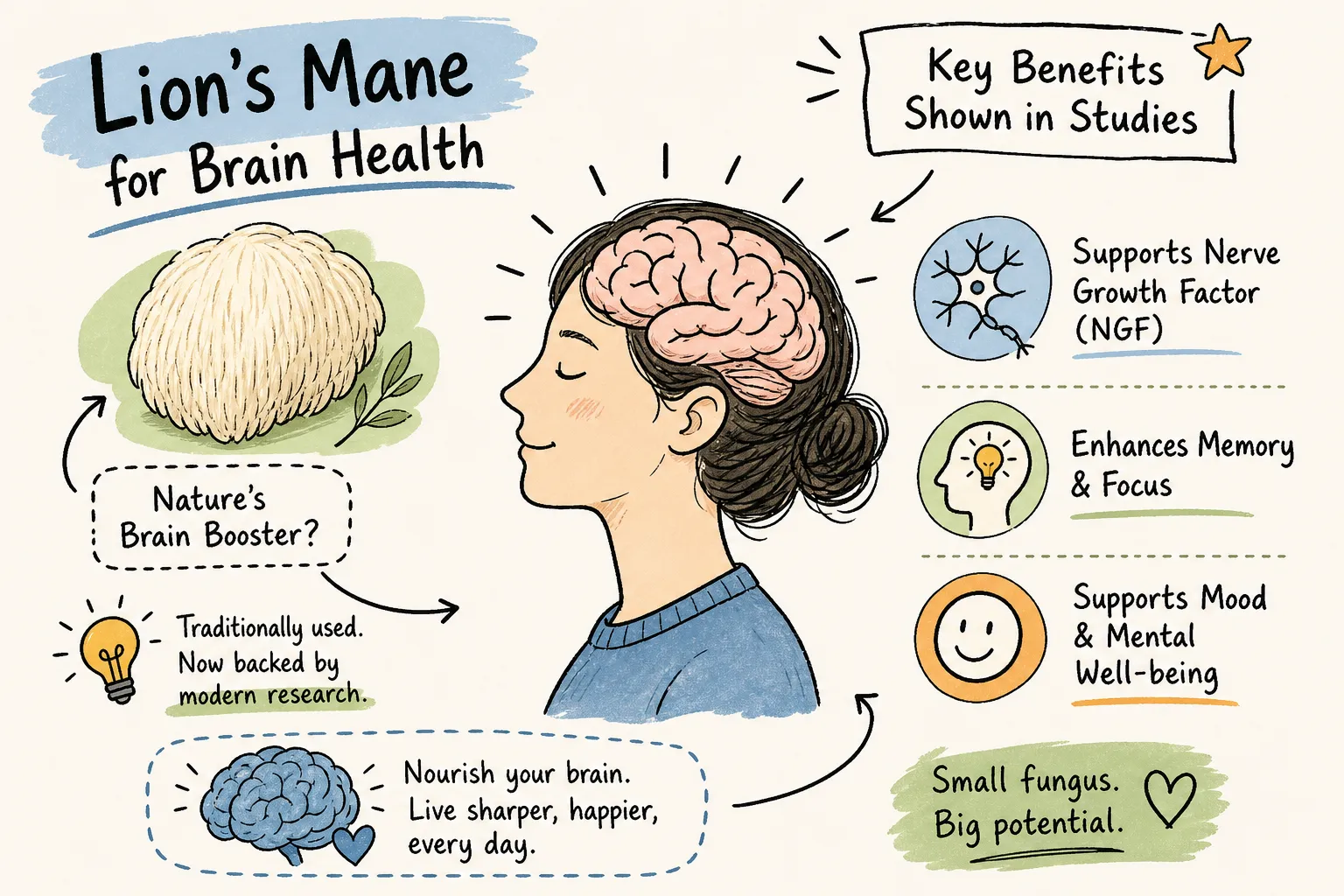
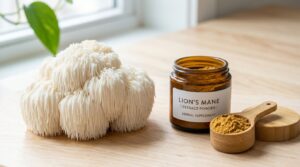
Lion’s mane has gone from obscure woodland fungus to one of the most talked-about cognitive supplements in the UK in the space of a few years. The claims have outrun the evidence by quite a distance. You’ll find it marketed as a brain-boosting, fog-clearing, memory-sharpening miracle, and most of that language is doing a lot of heavy lifting.
At UK Mushrooms Ok, we field questions about lions mane brain health every single week, from people who want a straight answer rather than a sales pitch. This article covers what the research actually shows, how the active compounds work at a cellular level, what clinical trials found and where they fell short, and how to use it practically if you decide it’s right for you. No hype, no overselling, just the evidence, clearly laid out.
Before looking at human trial results, you need to understand the biological mechanism. The “why” makes the trial data far more legible, and it’s also the strongest part of the science around Hericium erinaceus.
Lion’s mane contains two distinct families of bioactive compounds. Hericenones come from the fruiting body of the mushroom; erinacines come from the mycelium. Both groups stimulate nerve growth factor (NGF) biosynthesis, but through different pathways. Erinacine A is the most biologically active of the erinacines and carries the strongest in vivo evidence behind it.
It’s a lipophilic compound, meaning it dissolves in fat rather than water, which gives it a meaningful advantage: it crosses the blood-brain barrier via passive diffusion and is detectable in brain tissue within one hour of oral dosing in rats, based on preclinical pharmacokinetic data. These neuroprotective properties, supporting the conditions under which neurons can survive and function, are central to why researchers are interested in this compound.
NGF supports the growth, maintenance, and survival of neurons. In rat studies, erinacine A increased NGF content in the hippocampus and locus coeruleus, two regions central to memory and attention. Hericenones stimulate neurite outgrowth via TrkA and Erk1/2 pathways, and these effects were measurable in cell models. Hericenone D, in one in vitro study, produced NGF-inducing activity close to that of epinephrine, a potent NGF inducer.
The honest framing here is that the in vitro and animal data is consistent and replicated across multiple cell models and rodent studies, with several demonstrating reduced amyloid burden and improved behavioural outcomes. Human data is still catching up, and that gap matters when you’re deciding whether to spend money on a supplement.
Beyond NGF, H. erinaceus extracts have shown antidepressant-like effects in animal models through BDNF induction. One human study by Vigna et al. observed increased circulating pro-BDNF levels in overweight participants after eight weeks of supplementation. This is worth watching as the research develops, but the BDNF evidence in humans is considerably thinner than the NGF evidence at this stage.
This is where you need to pay close attention, because the trial landscape is smaller and more nuanced than the supplement industry would have you believe.
The Mori et al. (2009) randomised controlled trial remains the most cited and most robust positive result in the human literature. Thirty Japanese adults aged 50 to 80, all diagnosed with mild cognitive impairment (MCI), took 3g per day of dried lion’s mane powder over 16 weeks. The treatment group showed significantly improved scores on the Revised Hasegawa Dementia Scale at weeks 8, 12, and 16. Scores increased with duration, peaking at week 16. At the four-week follow-up after stopping supplementation, those improvements had disappeared.
Thirty participants is a small sample, and replication in larger trials hasn’t happened yet. That doesn’t make the result meaningless. It means you hold it appropriately, as promising evidence rather than proof. You can also review the public clinical trial registry for ongoing and completed studies to see how the trial landscape is developing (clinical trial record NCT06870136).
Saitsu et al. (2019) tested 31 healthy adults over 50, giving 3.2g per day for 12 weeks. MMSE scores improved versus placebo, but there was no significant change on two other cognitive tests: the Benton visual retention test and the verbal paired association test. Grozier et al. (2022) tested 24 college-age adults for just four weeks at a much higher dose of 10g per day, delivered in muffin form. No significant cognitive effect emerged on any measure.
A 2023, 2024 pilot study with 41 healthy young adults found that an acute dose improved processing speed on the Stroop task 60 minutes after taking 1.8g. Chronic supplementation over 28 days showed only a trend toward reduced stress, with no clear cognitive benefit overall. A separate 2025 trial found no significant effect on global cognitive function in young healthy adults, with some impairment in executive function measures under acute dosing.
Taken together, the positive findings from Mori et al. and Saitsu et al. are concentrated in older adults with existing cognitive changes, while the mixed and null results from Grozier et al. and the 2025 trial cluster in younger, healthy populations, a pattern worth noting if you’re seeking a productivity edge rather than supporting early decline.
The reversal of benefit in the Mori 2009 trial within four weeks of stopping is one of the most clinically relevant findings in this literature. It strongly suggests that any cognitive benefit from lion’s mane depends on consistent, ongoing supplementation. Short experiments followed by abandonment are unlikely to tell you much. This isn’t unique to lion’s mane, but it is worth being clear-eyed about.
Brain fog is one of the most common reasons people in the UK turn to lion’s mane. It’s also one of the least well-evidenced claims in the clinical literature, because no published trial has used brain fog as a primary outcome. The current evidence on focus and memory is extrapolated from cognitive test scores in impaired populations, which is a meaningful leap.
The strongest human evidence for memory support in the context of lions mane brain health is in adults aged 50 and over with early cognitive decline. At 3g per day over 16 weeks, the HDS-R improvement in Mori et al. (2009) was statistically significant. That matters. For prevention or treatment of Alzheimer’s dementia specifically, the evidence is considerably weaker: one near-year-long trial in early Alzheimer’s patients found no significant cognitive benefit, though there was some improvement in daily living activities.
For acute focus effects, the 2023, 2024 pilot showing improved Stroop task processing speed 60 minutes after a single dose is interesting but limited. It doesn’t mean lion’s mane acts like caffeine. The effect was on speed of processing, not on subjective alertness or executive function. Honest verdict: the signal is there in specific populations and contexts, but the noise is considerable everywhere else.
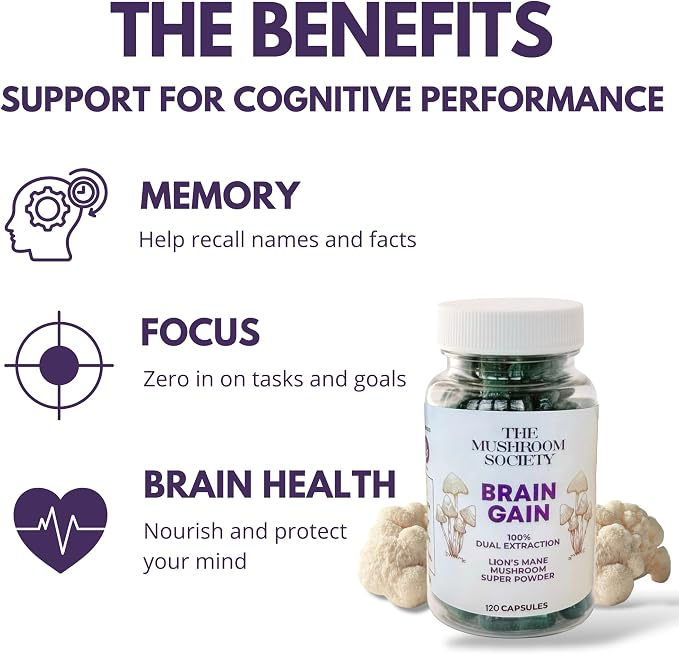
Human studies have used doses ranging from 1.8g to 10g per day. The most consistently positive outcomes cluster around 3 to 3.2g daily. A practical ceiling of 3,000mg per day is used across most published protocols, though some trials have used higher doses and no formal regulatory upper limit has been established. Doses in trials were typically divided across three to four servings rather than taken all at once, which mirrors the standard supplement protocols.
Hericenones from the fruiting body and erinacines from the mycelium both stimulate NGF, but through different pathways and with different pharmacokinetics. Erinacine A, from the mycelium, is lipophilic and crosses the blood-brain barrier more readily. Hericenones from the fruiting body show stronger in vitro NGF-inducing activity in some assays. No head-to-head human trial has compared the two directly. Dual-extract products aim to capture both compound groups, and given the different mechanisms involved, this approach makes sense pharmacologically.
When reading a label, look for products specifying beta-glucan content or erinacine A enrichment rather than just milligrams of raw powder. Unextracted mushroom powder has significantly lower bioavailability of active compounds due to chitin content, which the extraction process partially removes, though it should be noted that human pharmacokinetic data on this point remain limited.
If you prefer a liquid option that emphasises extract bioavailability, a tincture can be useful for people who dislike swallowing tablets; see our Organic Lion’s Mane Mushroom Tincture Extract for an example of a dual-extract format designed for mental clarity and nerve support.
Benefits in the Mori trial didn’t emerge until week 8 and reversed within four weeks of stopping. Short-term trials of four weeks in healthy adults consistently fail to show cognitive effects. If you decide to try lion’s mane for cognitive support, commit to a minimum of 12 weeks before drawing any conclusions. Less than that, and you’re not giving the mechanism enough time to operate.
The safety data for lion’s mane is reassuring. Across published randomised controlled trials, only mild gastrointestinal symptoms were noted, and these were balanced between treatment and placebo groups. A slight drop in uric acid was observed in one trial but remained within the normal range. Preclinical toxicology data show an LD50 in rats exceeding 5g/kg, indicating low acute toxicity. No serious adverse events have been attributed to lion’s mane in published clinical literature. For a broader synthesis of the medicinal mushroom literature and safety considerations, see this open-access review available via PMC.
That said, there are specific groups who should be cautious:
No significant drug interactions have been formally confirmed in clinical studies, but the theoretical concerns around anticoagulants and antidiabetics are worth a conversation with your GP if you’re on regular medication. That’s not excessive caution; it’s just sensible. For researchers and clinicians wanting a concise briefing on lion’s mane mechanisms and clinical considerations, the Cognitive Vitality Foundation has produced a researcher-focused summary for researchers.
The UK supplement market is flooded with imported mushroom products, and a significant proportion carry limited traceability and variable quality control. The label on a product tells you a great deal if you know what to look for.
Prioritise products that specify an extract ratio or a standardisation marker such as beta-glucan percentage or erinacine A content, rather than just a milligram weight of raw powder. Check whether the product uses fruiting body, mycelium, or a dual extract, and in what proportion. Third-party testing for heavy metals and contaminants matters more than it might sound, particularly given the volume of imported supplements on the market with no clear sourcing transparency.
Industry guidance from bodies such as the MHRA recommends that consumers look for independently verified certificates of analysis when choosing functional mushroom supplements. For recent pharmacology and extraction-method discussion that can help you interpret labels and extract claims, see this ScienceDirect review on Hericium erinaceus pharmacology and extraction.
In the interest of transparency: UK Mushrooms Ok produces its own lion’s mane extract. It is sourced from British micro-farms, and our formulation takes into account the compound considerations covered in this article, extraction method, erinacine A content, and standardisation. We’d encourage you to apply the same label-reading criteria to our product as to any other.
For anyone starting a cognitive wellness routine, a clean, traceable, dual-extract product gives you a reliable foundation against which to assess how the supplement works for you personally. If you’re looking for a high-dose tablet option that includes supporting nutrients for absorption, consider our Lion’s Mane Supplement 4000mg with Vitamin B1 & Black Pepper, and for formulations targeted at daily focus support see the Lion’s Mane Focus Formula.
The mechanistic case for lions mane brain health is solid at the preclinical level. The erinacines and hericenones are real, their NGF-stimulating and neuroprotective effects are well-documented in vitro and in animal models, and erinacine A crosses the blood-brain barrier. That part of the science is not in dispute. For readers wanting a deeper dive into the broader clinical and preclinical literature on medicinal mushrooms, this ScienceDirect article and the PMC review linked above are reliable starting points.
The human clinical picture is early, not absent. There is one meaningful positive RCT in adults with mild cognitive impairment (Mori et al., 2009), a handful of mixed results in healthy adults, and a developing picture of acute processing speed benefits. The evidence base is encouraging enough to make lion’s mane worth considering, particularly if you are over 50 and experiencing early cognitive changes, but not strong enough to support the extravagant claims you’ll encounter in most marketing.
If you decide to try it: 3g per day of a quality dual-extract, split across two to three servings, for a minimum of 12 weeks. Consistency matters far more than dose. Safety is not a major concern for most healthy adults, but speak to your GP if you’re on regular medication. And if you want a clean, UK-sourced starting point, UK Mushrooms Ok is where we’d point you.
The Simple Price Answer Reishi mushroom extract costs £10–£35 per month depending on quality and
The Real Answer The best chaga mushroom in the UK comes from UK Mushroom’s OK,
The Direct Answer The best lion’s mane products in the UK come from Our Shop